
Vector Search on GPU Databases
Vector search sounds mysterious until you map it to familiar database concepts.
Under the hood, it is a retrieval system that does this:
- Represent content as vectors
- Store vectors efficiently
- Find nearest neighbors
- Rank top results
- Return responses within strict latency targets
The terms are different, but the engineering questions are familiar: data representation, access path, indexing strategy, query latency, and hot-path optimization.
The Short Version
Vector search is nearest-neighbor retrieval over high-dimensional coordinates.
Instead of exact match queries like:
SELECT *
FROM products
WHERE category = 'laptop';
vector retrieval does:
query vector -> nearest stored vectors
That means retrieval by similarity and ranking, not by equality or lexical match alone.
What an Embedding Is
An embedding is a numerical representation of meaning.
In DBA language: it places content into coordinates in a high-dimensional space so semantically related items are close, even when exact text differs.
Traditional indexes optimize exact or ordered lookups. Embeddings optimize semantic proximity.
Traditional Search vs Vector Search
| Search Type | Matching Style | Best At |
|---|---|---|
| Exact lookup | Equality/ordered values | IDs, keys, strict filters |
| Full-text search | Lexical match | Terms, phrases, keyword relevance |
| Vector search | Semantic similarity | Meaning-based retrieval |
Production systems usually need all three modes together.
End-to-End Query Flow
- Source content is chunked (docs, tickets, KB, chats, logs).
- Embedding model converts each chunk to a vector.
- Vectors are stored with metadata.
- User query is embedded.
- Similarity search returns nearest candidates.
- Optional reranking produces final top-k results.
DBA Mental Model
| Traditional DB Concept | Vector Search Equivalent |
|---|---|
| Row | Content item/chunk |
| Indexed column | Embedding vector |
| Equality predicate | Similarity function |
| Top-N query | Top-K nearest neighbors |
| Post-filtering | Metadata filtering + reranking |
This is not a different universe. It is a new retrieval access pattern with familiar systems tradeoffs.
Why GPUs Help
Similarity scoring compares one query vector with many stored vectors. At scale, that means repeated arithmetic over large arrays:
- Dot product
- Cosine similarity
- Euclidean distance
That is exactly the class of workload GPUs accelerate well: the same math repeated many times in parallel.
Exact Search vs ANN
Exact vector search compares against all candidates. It is accurate but costly at large scale.
ANN (Approximate Nearest Neighbor) uses indexing structures to reduce search space and hit practical latency targets.
In practice:
- ANN narrows candidate sets quickly.
- GPU acceleration scores and ranks large candidate sets efficiently.
That combination is why vector search and GPU databases are frequently paired.
Where This Fits in the Data Stack
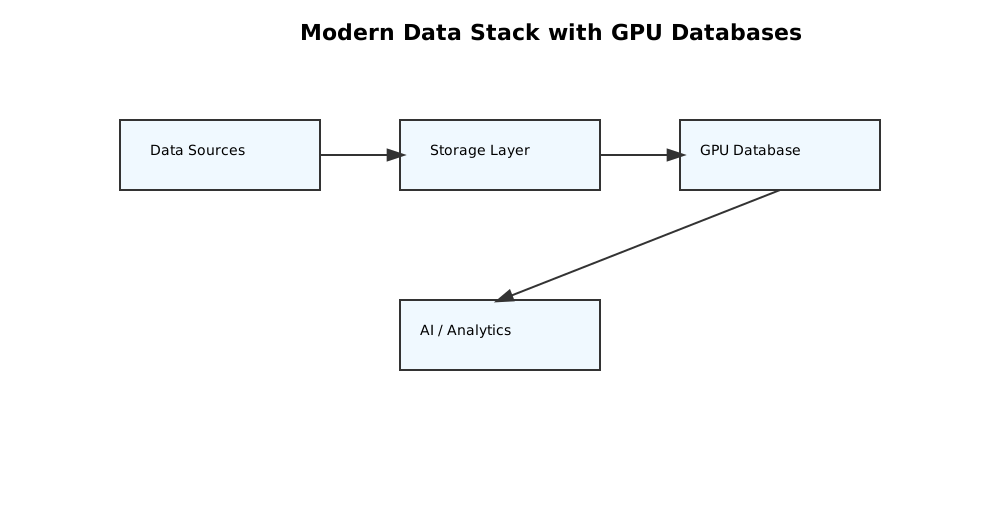
Production retrieval usually combines:
- Metadata filters (tenant, region, ACL scope, content type, time window)
- Lexical/keyword retrieval
- Vector similarity retrieval
- Reranking and business logic
This is why databases still matter deeply in AI retrieval systems: governance, filtering, structure, and access control do not disappear.
Where GPUs Are Worth It
GPU acceleration is usually worth serious consideration when:
- Vector corpus is large
- QPS is meaningful
- Latency targets are strict
- Candidate scoring dominates runtime
- Retrieval is user-facing
- Reranking/inference are in the same serving path
CPU-only can be enough when:
- Corpus is small
- QPS is low
- Latency constraints are loose
- Retrieval is offline or batch
Comparison Table
| Dimension | CPU Vector Search | GPU Vector Search |
|---|---|---|
| Setup complexity | Lower | Higher |
| Small datasets | Usually fine | Often overkill |
| Large candidate scoring | Can bottleneck | Strong fit |
| Throughput | Moderate | High |
| Latency under load | Degrades sooner | Stronger at scale |
| Best fit | Smaller/simpler workloads | Large-scale retrieval and ranking |
Key Takeaways
- Vector search is nearest-neighbor retrieval over embeddings.
- Embeddings represent semantic proximity, not exact text equality.
- ANN is essential at scale because exhaustive search is too slow.
- GPUs help because similarity scoring is repeated vector math.
- Production retrieval is usually hybrid: vector + keyword + metadata + reranking.
- Databases remain central for structure, filtering, security, and operational control.
Vector search is not AI magic. It is a retrieval architecture problem with familiar database tradeoffs and a new compute profile.
Comments