
Why Databases Are Moving Toward GPU Execution Engines
The CPU-centric query engine is not being replaced — it is being augmented, and the teams who are not planning for that shift are about to face a capacity ceiling on their analytical workloads.
Situation
Database engines were designed around one default assumption: the CPU is the center of query execution. That was the right design for an era dominated by OLTP, indexed lookups, branch-heavy logic, and transaction coordination. Workload shape has changed. Modern platforms increasingly need to support large analytical scans, interactive dashboards, join-heavy columnar queries, vector search and retrieval, and AI-adjacent ranking and reranking. CPU-only systems are being asked to handle execution patterns they were not optimized for.
The Problem
The operational symptom is predictable: a query that looked fine at 10 million rows becomes a sustained 60-second runtime at 10 billion rows, and adding more CPU capacity produces diminishing returns. The underlying problem is structural. CPU execution is sequential within a core — even well-parallelized CPU queries are constrained by thread count, cache pressure, and branch prediction overhead. The expensive paths in modern analytical workloads — scan, filter, join, aggregate — are massively data-parallel operations, not coordination-heavy operations. CPUs are excellent at coordination. They are less efficient at executing the same arithmetic operation across a billion rows.
The core question for operators: when does a GPU-accelerated execution engine produce a different result than throwing more CPU capacity at the problem?
GPU-Accelerated Database Architecture
| Layer | CPU-only | GPU-augmented |
|---|---|---|
| Planning and coordination | CPU | CPU |
| Heavy analytical execution | CPU | CPU + GPU |
| AI retrieval and vector serving | External stack | Integrated into the data platform |
The shift is not CPU replaced by GPU. The shift is: CPU for control, GPU for throughput.
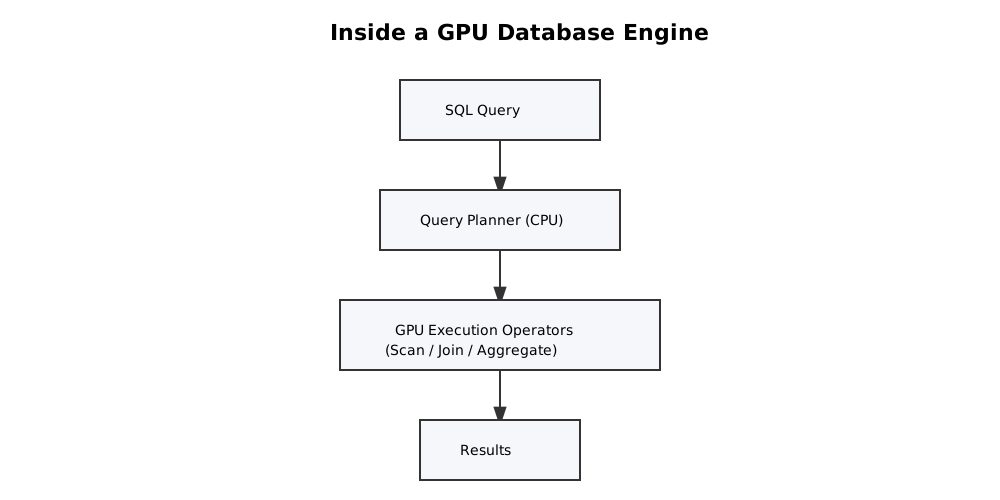
What problem GPUs solve
A lot of analytical SQL reduces to this execution shape:
SCAN -> FILTER -> PROJECT -> JOIN -> AGGREGATE
Take:
SELECT country, SUM(revenue)
FROM events
GROUP BY country;
At billion-row scale, this is a throughput problem. The engine repeatedly does similar work — read values, compare values, transform values, aggregate partial results — over large datasets. That repeated, data-parallel pattern maps well to GPU execution.
Why columnar storage enabled the shift
GPU execution fits far better with columnar data than row-heavy transactional layouts. If a query only needs price and quantity, a columnar engine can feed only those vectors into execution. That aligns with GPU-friendly flow:
vector in -> vector transform -> vector reduce
The industry trend followed a progression: vectorized execution → columnar storage and compression → GPU-aware operator offload.
Why AI is accelerating adoption
AI-oriented data systems increasingly require embeddings, nearest-neighbor retrieval, reranking, vector similarity, and inference near data. Those are not classic OLTP operations. They align with accelerator-friendly execution patterns, making GPU-capable systems easier to justify for combined analytical + AI workloads.
Architecture evaluation checklist
- What dominates the hot path: transactions, scans, joins, vector math, or ranking?
- Is the data layout GPU-friendly: columnar, batched, predictable access?
- Is the workload large enough to amortize offload overhead?
- Is the bottleneck compute, or actually data movement, modeling, or partitioning?
In Practice
NVIDIA’s RAPIDS cuDF library documents the design split explicitly: the GPU handles columnar data operations while the CPU handles query planning, result finalization, and control flow. The documented limitation is PCIe transfer overhead — data movement between CPU memory and GPU memory is the dominant latency cost for small-to-medium datasets. RAPIDS’ own documentation recommends GPU offload only when the working set is large enough that the transfer overhead is amortized across the computation.
PostgreSQL extensions for GPU offload, such as PG-Strom (documented at heterodb.com), follow the same documented hybrid pattern: the PostgreSQL planner runs on CPU, while scan-heavy and join-heavy operators are offloaded to the GPU. PG-Strom’s documented design states that only operators with high arithmetic intensity are candidates for GPU offload — point lookups and index scans remain on CPU.
DuckDB’s documented vectorized execution (CPU-based, not GPU) is a useful reference point for the floor: a CPU-based columnar engine can execute analytical queries at speeds that were GPU-exclusive five years ago, which means the decision to add GPU hardware requires a workload that exceeds what modern in-process columnar execution can handle.
Where It Breaks
| Scenario | What breaks | Why |
|---|---|---|
| GPU for small indexed lookups | No throughput gain, higher latency | GPU kernel launch overhead exceeds the per-request compute time |
| GPU for write-heavy OLTP | Incorrect fit — no benefit | Transactional writes are coordination-bound, not compute-bound |
| GPU for branch-heavy procedural logic | Falls back to CPU or performs worse | Divergent execution paths across GPU threads reduce parallelism |
| GPU without columnar storage | Poor data locality and excess data movement | Row-oriented layouts require reading irrelevant columns into GPU memory |
| Adding GPU without profiling the hot path | Wasted infrastructure spend | GPU acceleration only moves the needle when compute, not I/O or coordination, is the bottleneck |
What to Do Next
- Problem: CPU-only analytical engines hit a scalability ceiling on scan-heavy, aggregate-heavy workloads — and that ceiling arrives earlier as AI retrieval and vector search enter the data platform.
- Solution: Classify hot paths by execution pattern first; move scan-heavy, arithmetic-heavy workloads to GPU-accelerated execution while keeping planning, coordination, and OLTP on CPU.
- Proof: Run your top five analytical queries on a GPU-enabled instance or a GPU-accelerated engine such as RAPIDS cuDF, compare elapsed time and I/O throughput, and confirm the query is actually compute-bound (not I/O-bound) before attributing speedup to GPU offload.
- Action: This week, profile your three slowest analytical queries and determine whether the bottleneck is CPU compute, memory bandwidth, storage I/O, or query plan shape — only the CPU compute bottleneck is a GPU-offload candidate.