
CPU vs GPU vs TPU Explained for Database Engineers
A lot of infrastructure conversations get confusing the moment hardware enters the discussion.
People say things like:
- GPUs are faster than CPUs.
- TPUs are for AI.
- CPUs are old-school.
- GPUs will replace everything.
That framing is wrong.
The better question is:
What kind of workload is this hardware optimized to execute?
If you are a database engineer, you already know this pattern:
- OLTP workloads behave differently from OLAP workloads.
- Indexed point lookups behave differently from full scans.
- Row-by-row execution behaves differently from vectorized execution.
- Coordination-heavy systems behave differently from throughput-heavy systems.
CPU, GPU, and TPU are different execution engines for different compute patterns.
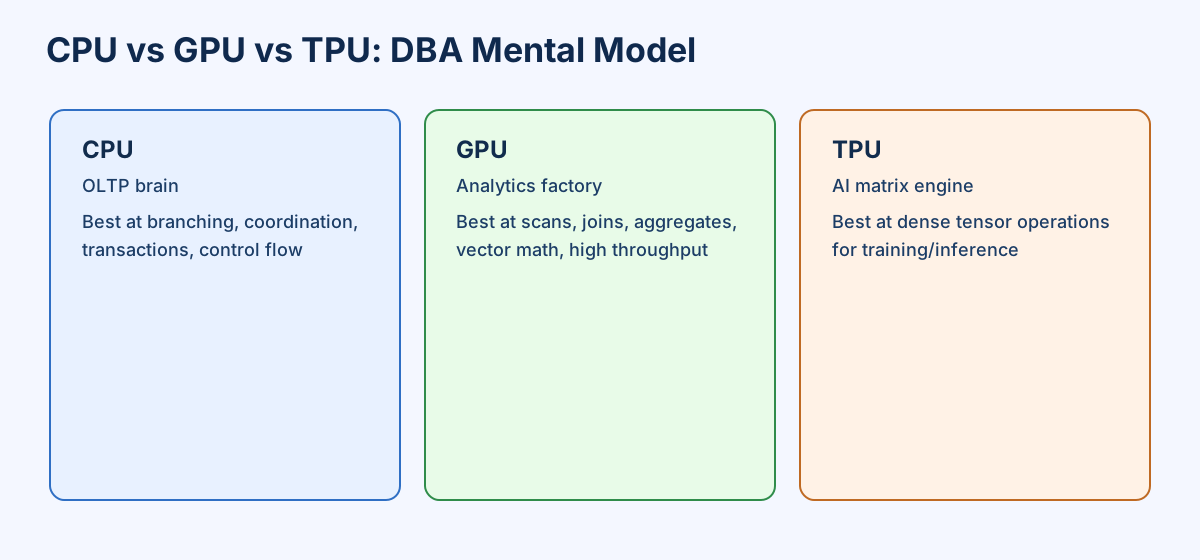
The Short Version
| Hardware | DBA Mental Model | Best At |
|---|---|---|
| CPU | OLTP execution brain | Branching, coordination, transactions, mixed workloads |
| GPU | Parallel analytics engine | Scans, filters, joins, aggregations, vector math |
| TPU | Matrix math appliance | Dense AI tensor operations and model inference/training |
If you remember one line, use this:
CPU is for decision-heavy work. GPU is for throughput-heavy work. TPU is for dense AI math.
What a CPU Really Is
A CPU is designed to be general-purpose. It handles many instruction types efficiently:
- Branching
- Pointer chasing
- Transaction logic
- Conditional execution
- Scheduling and interrupts
- Complex control flow
Think of a CPU as a traditional relational engine running OLTP traffic.
SELECT *
FROM orders
WHERE customer_id = 123
AND status = 'SHIPPED';
This is CPU-friendly because it involves index lookups, branching, and low-latency response patterns.
Where CPUs Win
CPUs usually win when the workload is:
- Transactional
- Branch-heavy
- Latency-sensitive
- Coordination-heavy
- Dominated by smaller irregular queries
What a GPU Really Is
A GPU is not just a faster CPU. It is built for repeating the same operation across massive data volumes in parallel.
Think of a GPU as a massively parallel analytics engine optimized for:
- Huge scans
- Repeated arithmetic
- Columnar execution
- Vector operations
- Parallel filtering and partial aggregation
SELECT SUM(price * quantity)
FROM sales;
With billions of rows, this operation is repetitive and parallelizable, which maps well to GPU threads.
Where GPUs Win
GPUs usually win when the workload is:
- Scan-heavy
- Arithmetic-heavy
- Batch-oriented
- Highly parallelizable
- Throughput-driven
What a TPU Really Is
A TPU is more specialized than CPU or GPU. It is designed for dense matrix and tensor math used heavily in neural networks.
Think of a TPU as a purpose-built model-math execution appliance.
Matrix A x Matrix B
TPUs are not general database accelerators. They are strongest when model computation itself is the bottleneck.
Where TPUs Win
TPUs usually win for:
- Neural network training
- Large-scale inference
- Dense tensor operations
- Repeated matrix multiplications with regular shapes
Why This Gets Confusing
People use the word performance too loosely.
A CPU can beat a GPU on a small branch-heavy request. A GPU can outperform a CPU on a billion-row aggregate. A TPU can outperform both on dense model math.
So the right question is not “Which is faster?” It is “Faster for what execution pattern?”
DBA-Friendly Examples
Case 1: OLTP request
SELECT *
FROM users
WHERE id = 42;
Best fit: CPU
Case 2: Analytical query
SELECT country, SUM(revenue)
FROM events
GROUP BY country;
Best fit: GPU
Case 3: AI inference on embeddings
query_vector x embedding_matrix
Best fit: GPU for many practical retrieval workloads, TPU for dense model-math-heavy paths.
Comparison Table
| Dimension | CPU | GPU | TPU |
|---|---|---|---|
| Flexibility | Highest | Medium | Lowest |
| Best workload | Mixed/general-purpose | Parallel analytics | AI tensor math |
| Latency | Strong | Moderate | Workload-specific |
| Throughput | Moderate | Very high | Very high for AI |
| Branch-heavy logic | Excellent | Weak | Poor fit |
| OLTP | Best | Poor | Poor |
| Analytics | Decent | Excellent | General mismatch |
| ML inference | Decent | Strong | Excellent |
| Matrix multiplication | Okay | Strong | Best |
Where This Fits in Modern Architecture
Modern systems increasingly become heterogeneous:
- CPU owns planning, control flow, transactions, and orchestration.
- GPU owns scan-heavy analytics, vector similarity, and data-parallel compute.
- TPU owns specialized large-scale model execution.
The trend is not that CPU is dead. The trend is selecting the right execution engine for each hot path.
Practical Rule of Thumb
- Use CPU when logic and coordination dominate.
- Use GPU when throughput and data parallelism dominate.
- Use TPU when dense model math dominates.
Key Takeaways
- CPU, GPU, and TPU are optimized for different execution patterns.
- CPU remains the best fit for general-purpose and OLTP-heavy workloads.
- GPU is strongest for scan-heavy analytics and vector math.
- TPU is strongest for dense AI tensor operations.
- Ask “faster for what?” instead of “which is faster?”
If you already understand OLTP vs OLAP, row vs column execution, and latency vs throughput, you already have the right mental model for CPU, GPU, and TPU.
Comments