
SIMD vs SIMT Explained for Database Engineers
A lot of GPU discussions get confusing because people jump straight into terms like lanes, warps, thread blocks, and vector units.
For database engineers, the better starting point is:
How does the engine apply one operation over a large amount of data?
If you already understand vectorized query execution, row-at-a-time vs batch-at-a-time processing, and scan-heavy analytics, you already understand most of SIMD and SIMT.
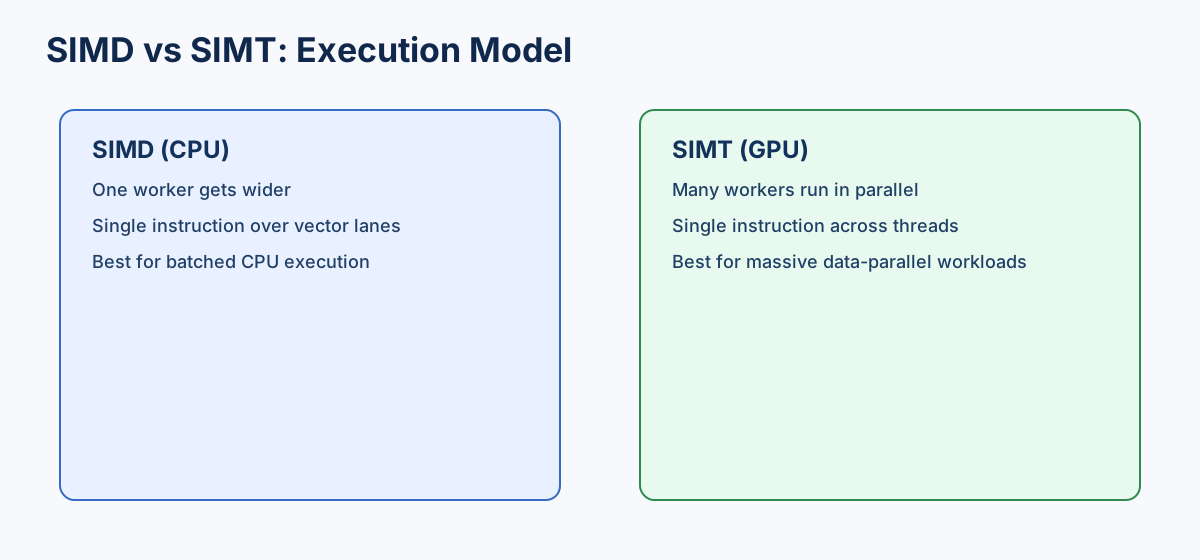
The Short Version
| Model | Plain English | Database Mental Model |
|---|---|---|
| SIMD | One instruction applied to multiple values in a batch | One strong CPU worker using vectorized execution |
| SIMT | One instruction executed by many threads at once | Thousands of GPU workers doing the same operator in parallel |
If you remember one line, remember this:
SIMD widens a worker. SIMT multiplies workers.
What SIMD Really Means
SIMD stands for Single Instruction, Multiple Data.
Instead of processing values one by one, the CPU can process a vector batch in one instruction step.
Database analogy: a vectorized executor processes batches of rows (for example, 1024 at a time) rather than one row at a time.
Think of SIMD as one executor worker becoming wider.
SIMD usually helps with:
- Vectorized scans
- Filters
- Projections
- Arithmetic-heavy expressions
- Batched comparisons
What SIMT Really Means
SIMT stands for Single Instruction, Multiple Threads.
This is the GPU model: many threads execute the same logical program over different slices of data at the same time.
Think of SIMT as the same operator fanned out across thousands of lightweight workers.
For example, with a large aggregate:
SELECT SUM(price * quantity)
FROM sales;
each thread handles part of the dataset in parallel, then partial results are reduced.
SIMT usually helps with:
- Large scans
- Parallel filtering
- Joins
- Aggregations
- Vector math and similarity calculations
The Real Difference
| Question | SIMD | SIMT |
|---|---|---|
| What gets parallelized? | Data within one worker | Work across many workers |
| Main hardware home | CPU | GPU |
| Typical shape | Vector lanes | Many threads |
| Best mental model | Wider executor | Many executor workers |
| Good for | Batched CPU execution | Massive data-parallel execution |
Another simple framing:
- SIMD = vertical widening
- SIMT = horizontal scaling inside the processor
Filter Execution Example
Take this query:
SELECT *
FROM orders
WHERE amount > 100;
Row-at-a-time engines compare one row at a time. SIMD-style execution compares batches in vectorized operations. SIMT-style execution lets thousands of GPU threads evaluate different row slices concurrently.
Both can improve performance, but with different scaling models.
Why SIMD Matters in Databases
SIMD is one reason modern analytical engines got much faster even before GPU offload became common.
A lot of CPU-side gains come from:
- Vectorized execution
- Columnar processing
- Batch operators
- Cache-friendly data layouts
SIMD tends to help when operations are repetitive, data is contiguous, branching is low, and batch processing is natural.
Why SIMT Matters in GPU Systems
SIMT is why GPUs can dominate certain analytical workloads.
When operations are regular and repeated over huge datasets, GPUs can keep massive thread pools busy and drive very high throughput.
SIMT tends to help when scan volume is high, per-row work is simple, and memory access is structured enough.
The Branching Problem
CPUs handle branching and irregular control flow well.
GPUs lose efficiency when threads diverge heavily (different branches across neighboring threads), because SIMT prefers regularity.
That is why GPUs often excel on regular aggregates and scans, but may underperform on branch-heavy, irregular logic.
Practical DBA Examples
Example 1: CPU-friendly vectorized query
SELECT SUM(price)
FROM fact_sales
WHERE date_key BETWEEN 20260101 AND 20260131;
Why SIMD helps: vectorized predicate evaluation and batched accumulation.
Example 2: GPU-friendly scan + aggregate
SELECT country, SUM(revenue)
FROM events
GROUP BY country;
Why SIMT helps: huge scan volume, repeated per-row work, parallel partial aggregation.
Example 3: Bad GPU candidate
SELECT *
FROM users
WHERE user_id = 42;
Why neither model matters much: tiny indexed lookup, latency dominates, limited parallel opportunity.
Key Takeaways
- SIMD means one CPU worker processes multiple values per instruction.
- SIMT means many GPU threads execute the same operation in parallel.
- SIMD is a core model behind fast CPU vectorized executors.
- SIMT is a core model behind GPU query acceleration.
- CPUs remain better for irregular, branch-heavy control flow.
- GPUs dominate highly parallel and repetitive analytical work.
The right question is not which model is better in general, but which model matches the workload shape.
Comments