
Why Databases Are Moving Toward GPU Execution Engines
For years, database engines were designed around one default assumption: the CPU is the center of query execution.
That was the right design for an era dominated by OLTP, indexed lookups, branch-heavy logic, and transaction coordination.
But workload shape has changed.
Modern platforms increasingly need to support:
- Large analytical scans
- Interactive dashboards
- Join-heavy columnar queries
- Vector search and retrieval
- AI-adjacent ranking and reranking
This is why more systems are becoming GPU-aware.
It does not mean CPUs are going away. It means the expensive path in modern analytics increasingly looks like a GPU problem.
The Short Version
| Layer | Old default | New default |
|---|---|---|
| Planning and coordination | CPU | CPU |
| Heavy analytical execution | CPU | CPU + GPU |
| AI retrieval/vector serving | External specialized stack | Increasingly integrated into the data platform |
The shift is not CPU replaced by GPU.
The shift is:
CPU for control, GPU for throughput.
What Problem GPUs Are Solving
A lot of analytical SQL reduces to this execution shape:
SCAN -> FILTER -> PROJECT -> JOIN -> AGGREGATE
over large datasets.
Take:
SELECT country, SUM(revenue)
FROM events
GROUP BY country;
At small scale, this is trivial. At billion-row scale, it is a throughput problem.
The engine repeatedly does similar work:
- Read values
- Compare values
- Transform values
- Aggregate partial results
That repeated, data-parallel pattern maps well to GPU execution.
Why CPU-Only Execution Bends
CPUs are still excellent for:
- Query planning and optimization
- Branch-heavy control flow
- Transactional coordination
- Low-latency request handling
But CPU-only paths are less ideal when hot paths are dominated by:
- Large scans
- Repeated arithmetic
- Batch column operations
- Very large group-bys
- Vector similarity math
This is the same architecture tension DB engineers already know from OLTP vs OLAP and row-store vs column-store decisions.
Inside a Hybrid Execution Pattern
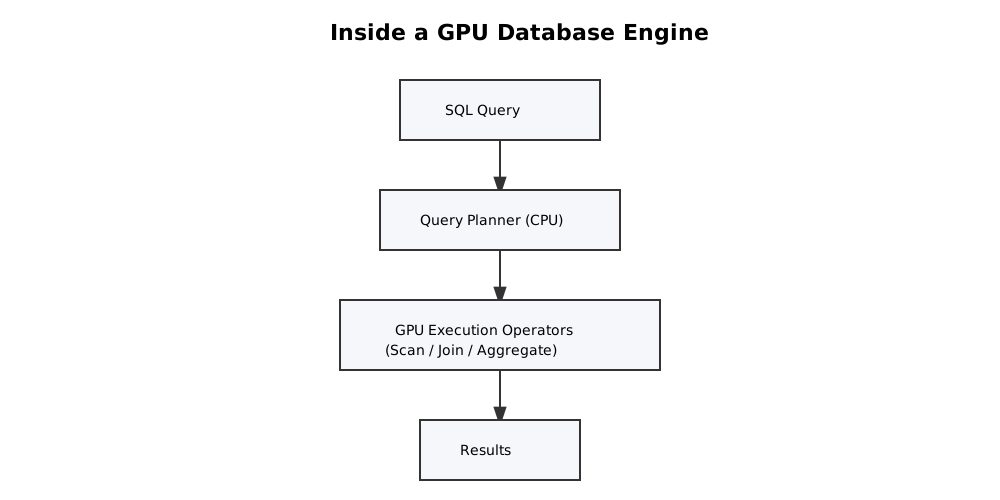
The practical pattern in many systems is hybrid execution:
- CPU handles parse, optimize, schedule, orchestrate, finalize.
- GPU handles scan/filter/project/join/aggregate-heavy operators.
In one line:
Keep the brain on CPU. Move heavy lifting to GPU.
Why Columnar Systems Enabled the Shift
GPU execution fits far better with columnar data than row-heavy transactional layouts.
If a query only needs price and quantity, a columnar engine can feed only those vectors into execution.
That aligns with GPU-friendly flow:
vector in -> vector transform -> vector reduce
This is why the industry trend often looked like:
- Vectorized execution
- Columnar storage and compression
- GPU-aware operator offload
Why AI Is Accelerating Adoption
AI did not create GPU database acceleration, but it is accelerating it.
AI-oriented data systems increasingly require:
- Embeddings
- Nearest-neighbor retrieval
- Reranking
- Vector similarity
- Inference near data
Those are not classic OLTP operations. They align with accelerator-friendly execution patterns.
Economics and Platform Convergence
This is not only about speed.
It is also about platform convergence. Teams increasingly want one platform to support:
- SQL analytics
- Search and retrieval
- Vector workloads
- AI-adjacent serving
As these workloads converge, GPU-capable execution becomes easier to justify.
Where GPUs Do Not Help Much
GPUs are not a universal upgrade. They are often a poor fit for:
- Tiny indexed lookups
- Write-heavy transactional traffic
- Branch-heavy procedural logic
- Workloads dominated by coordination instead of compute
Example:
UPDATE users
SET status = 'active'
WHERE id = 42;
That is usually still CPU territory.
Architecture Evaluation Checklist
When evaluating GPU execution, ask:
- What dominates the hot path: transactions, scans, joins, vector math, or ranking?
- Is the data layout GPU-friendly: columnar, batched, predictable access?
- Is the workload large enough to amortize offload overhead?
- Is the bottleneck compute, or actually data movement/modeling/partitioning?
Key Takeaways
- Databases are moving toward GPU execution because analytical workloads are increasingly massively parallel.
- The shift is strongest where hot paths are scan/filter/join/aggregate/vector-heavy.
- CPUs remain essential; modern systems are usually hybrid CPU + GPU.
- Columnar execution made GPU acceleration much easier to adopt.
- The right question is not “are GPUs better?” It is “does workload shape match the execution model?”
Modern database architecture is not CPU versus GPU. It is matching each part of execution to the right engine.
Comments